Through the Boston Children's Global Health Program, I would be working at JFK Hospital in Monrovia, Liberia as a rotating resident. I would be working on inpatient teams and assist attendings and specialists, and would have teaching responsibilities aimed towards the residents at the hospital, with a focus on pediatric cardiology, my eventual specialty.
I will be serving the pediatric population of Liberia in West Africa, with a focus on inpatient medicine and neonatology. I recently completed a rotation with the Indian Health Services in North Dakota and enjoyed working with the population there. I have been moved by the cuts to foreign aid that has removed life-saving support from different areas around the world and want to build on my population health experiences to support patients and other residents in an area of the world that is less well-resourced. Coming from a large academic hospital, I believe I will bring good experience to rotating teams and help drive decision making, and also will provide good teaching points and formal lectures to the residents there.
I expect to help inpatient pediatric teams by carrying patients, teaching lectures, and providing bedside care. I'm working with the global health team to set goals for an educational experience while I am there. I would hope to provide both excellent care and education that can be a benefit to patients and residents while I am there, and hopefully will continue to benefit the hospital community after I leave.






Practicing medicine in Liberia is full of challenges. Upon arrival to morning report, I was greeted with an opening sentence from the resident (finishing a 24hr shift) that was always an iteration: "Good morning. Over the 24-hour call we had 10 admissions and 4 deaths, 2 of the deaths were part of the admissions."
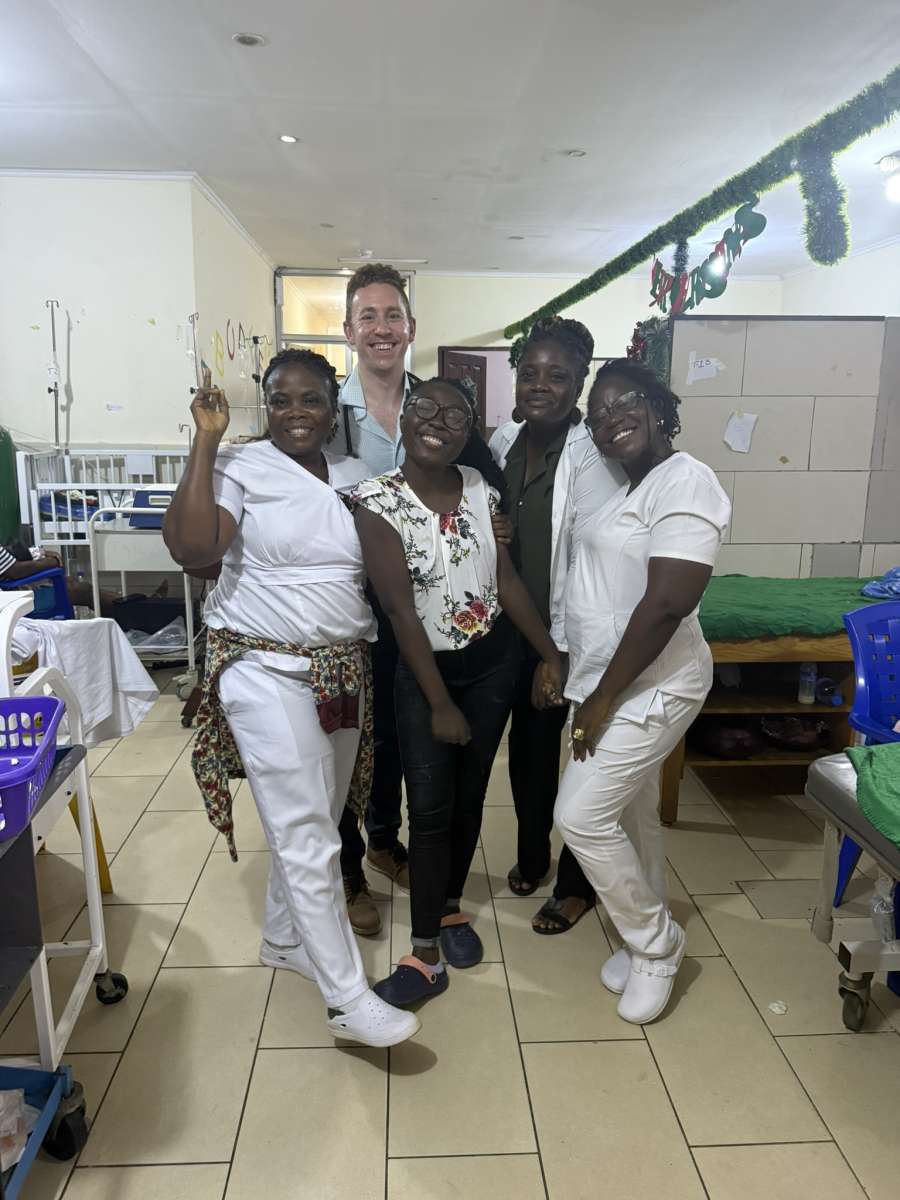
I worked with a group of four residents who are amongst the most inspiring people I've ever met. We worked incredibly challenging shifts in an incredibly hot room that serves as the pediatric ED, wards, and ICU, all in one. The residents write all notes and orders by hands. There is no Epic chat or paging system for a nurse to let you know a patient is desaturating. In fact, with one cardiac monitor, one portable pulse oximeter, and two fingertip pulse oximeters, there are few ways to find out if your patient is desaturating at all. The physical exam becomes paramount, with limited resources to go around, rationing equipment becomes a common discussion. Which one of the bronchiolitic kids gets the last remaining CPAP machine? Is the adolescent with disseminated TB or the newborn with neonatal tetanus more deserving of the cardiac monitor? Decisions that served as thought exercises in medical school lectures become reality almost daily. Power strips and cords run all along the unit, as nurses and residents work to maximize the limited number of outlets, all while dealing with frequent, short power outages that interrupt positive pressure machines and epinephrine drips. The residents and nurses do not complain, they only raise their voice to ask for help, and they seldom take breaks.
As challenging it is to be a resident in Liberia, being a parent or a patient is unfathomably harder. Without public insurance, and in a fee-for-service model, parents work to find payment for chest X-rays ($25), basic labs ($10-20), or heaven forbid, a CT ($100, $150 with contrast). Median monthly incomes in Liberia range around $150-200. Chest films that happen almost instantaneously in my home hospital happen by the end of the day, or not at all. A 3-year-old transferred from a rural site with a BP of 190/120 and L-sided hemiparesis (this small room serves as the referral area for the country) was treated for a suspected cerebrovascular accident for 36 hours before a CT was finally arranged, showing tuberculoid meningitis as the cause. These parents find community in this small room, sharing food, money, hope, and prayers. What is predominantly hope occasionally turns to despair, as in this crowded catch-all room, every outcome is on display. Resuscitations take place on a wooden table, visible to most of the unit. Mourning of your child's loss unfortunately becomes a more public than private experience, witnessed by the other infants, children, and parents cramped together in this unit. There is little time for myself and the other residents to recover from these devastating outcomes, as you must balance end-of-life documentation with the sobering but important decision as to where the cardiac monitor should go next.
I saw a lot of diagnoses in Liberia that modern pediatricians may go their entire careers without encountering. What sticks with me most, however, are the children who succumbed to illnesses that we encounter every day. Infants with bronchiolitis are placed on a regimen of CPAP, suctioning, and hopeful watching. Nearly 50% of babies in Liberia are born outside of a hospital, and small complications can prove catastrophic. Hypoxic events at birth that would resolve with 10 puffs of PPV in a resourced setting turn into life-altering damage. The most jarring, yet frequent patient encounter I dealt with was that of a mother rushing into the unit with a baby wrapped in a blanket, cloth, or whatever garment was available. The room holds their breath as the newborn is unwrapped, hoping for a crying, pink baby. While this is occasionally the case, these presentations are often dire, requiring resuscitation that is performed to standard, but often comes too late. For the illnesses you don't encounter every day, they can offer a different kind of hopelessness. I worked extensively with a 12-month old boy with Tetralogy of Fallot and his mother, age 18. He initially presented with viral symptoms. Appearing visibly cyanotic and malnourished, but interactive, I attach the lone handheld pulse oximeter to see a reading of 52, as he gives a wailing cry. The incredible resilience of babies and infants is on full display in this small unit. He miraculously improves with supportive therapy, but as I speak with her prior on my last day, his mom continues to worry that she cannot raise the $~10,000 needed to fund travel for a trip to India, where a late, but corrective surgery serves as their only hope.
To answer the prompt's question of "Tell us about the people who were impact by your trip", I don't think anyone was more impacted than myself. I have never been more inspired than I was by the residents, parents, and children I met in Liberia. I hope that in teaching sessions and moments of providing care with the residents, that I was able to provide knowledge that will help them as they encounter more challenges throughout their training. Truthfully, their resilience, grit, and ingenuity made more of an impact on me than I could ever have on them. I felt a tremendous sense of purpose working in this cramped unit, one I've been searching for throughout the last year of my residency. As I've returned to the US with anecdotes of my experience, many colleagues respond that I must feel grateful for the care, attention, and resources we can provide here. While that is the case, I believe the sentiment is misplaced. Ultimately, every child in the world deserves that level of care. The solutions to the problems facing our children in Liberia, and elsewhere, are not simple, but we have found some of them before. Notably, cuts to foreign aid have been devastating to this region. A Lancet study showed that the near-complete dissolution of USAID could lead to over 4.5 million worldwide deaths of children younger than 5 by 2030. Although this number seems gaudy, I find it much more believable after my month there. As devastating as some moments were, the prevailing sentiment in this cluttered, combined unit was one of hope. There are few things more universal than a parent's hope for their child's future. I continue to hope that we can work towards ways to reverse the damage of aid cuts to this region and help children and families reach their full potential, and I believe it is worth fighting for.