We are working with the local residents and surgeons to serve Vietnam's underserved population. We will be doing a full range of plastic surgery procedures including reconstruction and craniofacial. We hope that by teaching the local residents and surgeons, they will be able to learn these procedures and provide future care to these patients in order to decrease the global burden for surgical need. Additionally by working with the local residents and surgeons, patients will have continuity of care for their postoperative and follow-up visits.
The local resident, surgeons, and patients will benefit from this trip. The Vietnamese population has a large underserved population of patients in need of complex reconstructive and craniofacial surgeries that local surgeons are unable to perform.
We hope to guide and teach the local residents and surgeons in pre-operative, operative, and postoperative care of these patients so once we have left, 1) there will be continuity of care for the patients we operated on and 2) the local surgeons can confidently perform these surgeries moving forward in order to help their patients.


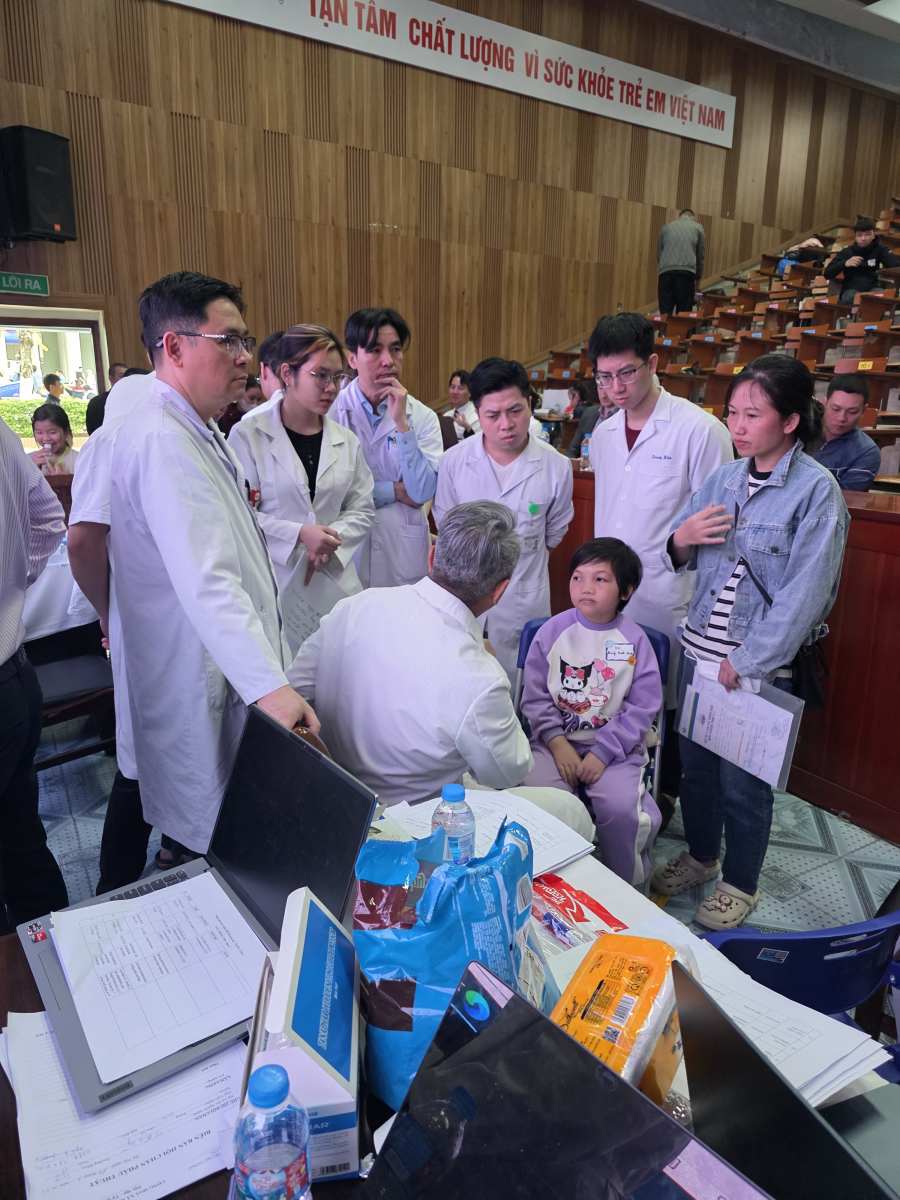


The patients who benefited from this mission were predominantly children presenting with congenital and acquired conditions requiring reconstructive surgery — with craniofacial anomalies comprising the majority of our operative volume. Among them were children born with cleft lips and palates, craniosynostosis, orbital and nasal deformities, and soft tissue abnormalities of the face and scalp. We also performed reconstructive procedures across the body, addressing post-burn contractures, hand and extremity deformities limiting function, and other conditions that impair a child's ability to participate fully in daily life.
What distinguished this mission from traditional humanitarian surgical trips was its deliberate emphasis on sustainability and capacity building. Rather than operating independently and departing, our team worked side-by-side with local plastic surgeons and trainees at an established academic medical center in Vietnam — teaching operative technique, intraoperative decision-making, and postoperative management in real time, on real patients. The local surgeons were not observers; they were participants, and the explicit goal was to leave behind a more capable surgical team than we found.
This model reframes who is ultimately impacted. The children we treated during the mission benefited directly and immediately — receiving surgical care for conditions that cause functional impairment, social stigma, and long-term developmental consequences. But the more expansive impact belongs to the patients those local surgeons will go on to treat for the remainder of their careers: the children who will present to that hospital next month, next year, and a decade from now, and who will receive better care because of the knowledge transferred during this trip. Sustainable capacity building multiplies the reach of a single mission exponentially.
The postoperative component of our teaching was particularly meaningful. In many global health surgical missions, the operation is treated as the endpoint — but complications, wound care, and follow-up are where outcomes are truly made or lost. By emphasizing postoperative protocols and training local teams to recognize and manage complications independently, we worked to close a gap that traditional mission models often leave open. The families of these patients deserve not only a successful operation, but a care team equipped to see them through recovery.
The impact of this mission, then, is best measured not in case volume alone, but in the compounding effect of surgical education delivered at a high-volume academic center to surgeons who will carry these skills forward — making reconstructive care for children with craniofacial and other complex anomalies more reliably accessible within the Vietnamese healthcare system itself.