I will travel to Kibuye Hope Hospital in Burundi with physician colleagues to implement and rigorously evaluate a structured point-of-care ultrasound (POCUS) training program for frontline clinicians. In resource-limited settings where advanced imaging is scarce, POCUS significantly improves diagnostic accuracy and clinical decision-making. Although many district hospitals in Burundi possess ultrasound machines, few physicians have formal emergency ultrasound training, limiting effective use of existing equipment.
The project includes a three-day, hands-on POCUS course delivered to two sequential groups (12–14 physicians total), followed by a one-day training-of-trainers program for selected participants. The curriculum focuses on high-impact applications aligned with local disease burden: Extended Focused Assessment with Sonography for Trauma (E-FAST), cardiac, pulmonary, deep vein thrombosis (DVT), and Focused Assessment with Sonography for HIV-Associated Tuberculosis (FASH) examinations.
Training effectiveness will be assessed through pre- and post-course knowledge testing, an Observed Structured Clinical Examination (OSCE), and longitudinal follow-up of ultrasound utilization and skill retention at three and six months.
This initiative expands bedside diagnostic capacity, supports more timely and informed clinical decision-making, and establishes a sustainable, locally led education model designed to continue beyond the initial training.
The primary participants are general practitioners, transitional-year interns, and surgical residents at Kibuye Hope Hospital, a regional referral center serving a largely rural population in western Burundi. These clinicians provide frontline care within a health system with limited access to advanced imaging and subspecialty services.
Burundi is consistently ranked among the world’s poorest countries, and patients frequently face significant barriers to diagnostic testing, including cost, travel distance, and infrastructure limitations. While ultrasound machines are present in many district hospitals, limited formal training restricts their clinical impact.
By strengthening physician competency in bedside ultrasound, this project directly equips clinicians with practical, high-yield diagnostic tools. Indirectly, the project will benefit hundreds to thousands of patients served by the hospital annually. Improving clinicians’ ability to rapidly diagnose internal bleeding, cardiopulmonary illness, thromboembolic disease, and HIV-associated tuberculosis has immediate implications for morbidity and mortality.
This setting was selected following a needs assessment demonstrating substantial training gaps and strong local engagement. Investing in frontline clinicians in a resource-constrained environment maximizes both immediate patient benefit and long-term system capacity.
The immediate impact will be measurable improvement in physician knowledge, technical competency, and confidence in performing high-yield POCUS examinations. We anticipate statistically significant gains in pre- to post-training assessment scores, with at least 80% of participants achieving competency on standardized OSCE evaluation.
At six months, follow-up surveys and scan logbooks are expected to demonstrate increased ultrasound utilization and sustained skill retention. Expanded bedside imaging capacity has the potential to improve diagnostic accuracy, reduce delays in care, and decrease unnecessary patient transfers.
Sustainability is central to this effort. Through the training-of-trainers component, selected participants will be prepared to independently conduct future POCUS courses using the same curriculum and assessment framework. Establishing baseline metrics enables continued evaluation, refinement, and scalability.
Rather than delivering episodic clinical care, this project invests in durable local expertise—advancing long-term health system strengthening and expanding access to high-quality emergency and inpatient diagnostics.




Sustainable POCUS Training in Rural Burundi
Thanks to the support of the Doximity Foundation, I had the opportunity to travel to Kibuye Hope Hospital in Gitega Province, Burundi, as part of our project, Sustainable POCUS Training in Rural Burundi. Together with two emergency medicine physician colleagues, I spent 10 impactful days teaching point-of-care ultrasound (POCUS) to resident and attending physicians at this rural teaching hospital.
Our curriculum covered basic ultrasound concepts as well as cardiac, pulmonary, extended focused assessment with sonography in trauma (eFAST), deep vein thrombosis (DVT), soft tissue, and focused assessment with sonography for HIV-associated tuberculosis (FASH) ultrasounds. Through lectures in French, hands-on scanning sessions, and small-group image review, 24 learners completed a comprehensive course that included pre- and post-course assessments and objective structured clinical examinations (OSCEs). Average assessment scores improved substantially, reflecting meaningful gains in both ultrasound knowledge and practical clinical skills.
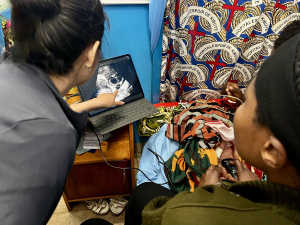
What I remember most vividly, is the enthusiasm of the physicians we worked with. Every day, learners arrived eager to scan, eager to ask questions, and eager to apply their new skills to patient care. During bedside sessions, participants actively sought opportunities to perform examinations and discuss how ultrasound findings could influence clinical decision-making.
One particularly memorable moment occurred when a resident with no prior formal ultrasound training identified a large pleural effusion in a patient presenting with cough and respiratory distress following recent treatment for malaria. After reviewing the images with our team, the resident confidently explained the findings to the patient, family, and care team. The patient subsequently underwent a diagnostic and therapeutic thoracentesis with significant improvement in symptoms. Watching that resident move from learner to clinician-teacher in real time underscored the power of practical bedside education.
Sustainability was a central goal of the project. Kibuye Hope Hospital already possessed several portable ultrasound machines, and our team supplemented these resources with additional handheld ultrasound devices and an ultrasound stand, all of which remain on site. We also conducted a Train-the-Trainers course for six participants selected for their aptitude and leadership potential.
Watching these participants evolve from learners to educators was one of the most rewarding aspects of the trip. Within hours, they were preparing and delivering practice lectures, coaching their peers through scanning techniques, and thoughtfully incorporating feedback into their teaching. One participant, who only days earlier had been learning cardiac ultrasound concepts herself, stood before the group and confidently delivered part of a lecture, fielding questions and engaging her colleagues with remarkable poise and humor. She was also able to provide constructive feedback in a sensitive and appropriate manner. Moments like these gave me confidence that ultrasound education at Kibuye Hope Hospital will continue to flourish long after our departure.
As I prepared to leave Kibuye, it became clear that the most important outcome was what these physicians were now prepared to do next. Seeing clinicians integrate ultrasound into patient care and watching future instructors embrace their new roles as educators gave me tremendous optimism for the future of POCUS in this rural region. Their curiosity, dedication, and commitment to their patients were inspiring, and I am deeply grateful to the Doximity Foundation for making this experience possible.
-Aliza Weinman, MD MPH