Point-of-care ultrasound (POCUS) has become an indispensable tool in modern healthcare, enhancing diagnostic accuracy, clinical efficiency, and patient safety. By enabling providers to
access real-time imaging, POCUS facilitates faster, better-informed clinical decisions in diverse settings, from emergency departments to primary care clinics. POCUS is portable, cost-effective, and readily accessible, making it especially valuable in resource-limited environments. Due to its importance, we have developed a POCUS/Critical Care Curriculum for house staff at Tamale Teaching Hospital, Ghana (TTH).
The POCUS and critical care curriculum will focus on developing proficiency in point-of-care ultrasound and emergency critical resuscitation, including labs and EKGs. The curriculum comprises three phases: Phase 1: Pre-Course Curriculum: Participants will engage in asynchronous, self-guided learning and virtual telelectures. Phase 2: On-Site Training The hands-on portion of the curriculum will be delivered over a five-day intensive in-person session at TTH. This phase focuses on building house staff competency in the core ultrasound domains, including cardiac, pulmonary, renal, aorta, abdominal, and DVT assessments. We will use the Butterfly ultrasound system to capture and store images for immediate feedback and learning. Once staff demonstrate proficiency with normal imaging, we will advance to simulation training at the Tamale Simulation Center. Here, participants will interpret real-time lab results, perform ultrasounds, and manage abnormal findings in a controlled environment. This phase will emphasize situational awareness, clinical context, and rapid decision-making skills. Finally, we will introduce ultrasound administration, setting up quality assurance (QA) protocols to maintain and assess ultrasound standards over time. Phase 3: Post-Course Support and Quality Assurance Following the in-person training, ongoing education and QA will be conducted virtually.
In collaboration with Dr. Al Hassan at TTH, our team has identified a need for a critical care curriculum focused on ultrasound training paired with key clinical skills such as EKG and ABG interpretation, with an emphasis on cardiac and critical care ultrasound. Currently, UDS/TTC lacks a phased array probe, and cardiac ultrasound is not part of their standard training. We aim to provide the necessary equipment and curriculum to introduce cardiac ultrasound, expose house staff to critical care scenarios, and integrate emergency medicine into their learning environment. This curriculum is designed to prepare house staff from various specialties, especially surgical, to manage critical care needs and emergencies seen across medical fields.
Our long-term goals are twofold.
Firstly, we will focus on sustainability and knowledge transfer by building a strong base of house staff proficient in POCUS, we aim to establish a culture of skill-sharing, where trained staff can mentor incoming cohorts. We will provide updates to the pre-course curriculum annually to ensure it remains current.
We will also foster cross-institutional collaboration. By hosting QA conferences via Project Echo, we can maintain a channel for ongoing learning and shared expertise between our institutions. We envision this partnership evolving into a lasting, collaborative network for quality ultrasound education and patient care.


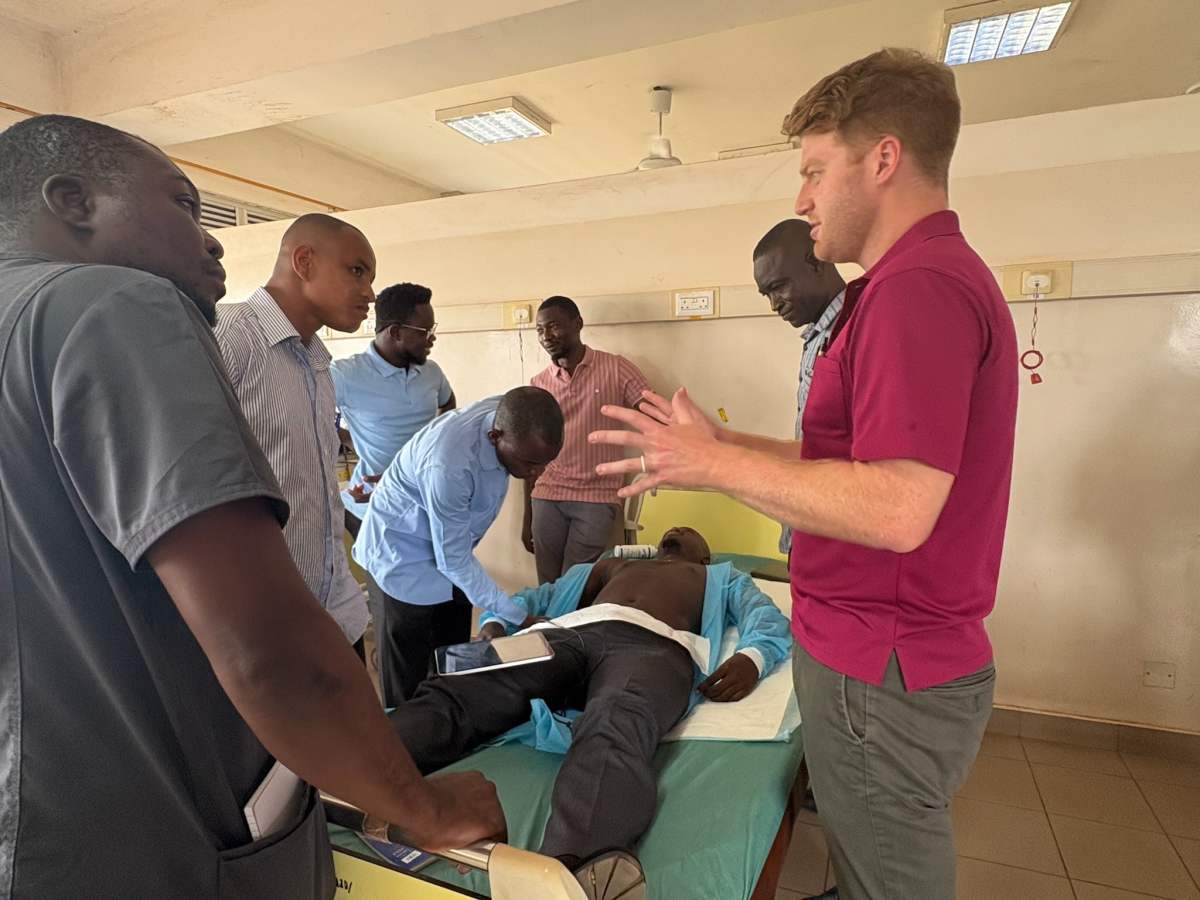

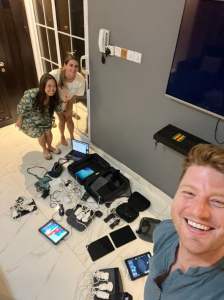


We were a part of a growing international collaboration between NYU School of Medicine and the Tamale Teaching Hospital in Tamale, Ghana. This project, supported in part through the Doximity Foundation, involved capacity-building through the implementation of bedside ultrasound at the hospital. At Tamale, there are a variety of logistical, financial, and social barriers to rapid diagnostic tests in critically ill patients, meaning the ability to implement low-cost and highly portable hand held ultrasounds is a boon for the amazing clinicians there.
We were able to run a didactic curriculum to familiarize the clinicians with bedside critical ultrasound before a series of practice scanning sessions on healthy volunteers (both pictured). Finally, we engaged with real-time clinical care in the hospital so trainees could scan their patients to see their suspected pathologies in action while getting real-time feedback.
The next steps for this project involve continuing education through virtual didactic sessions and an asynchronous review process to give learners feedback on their future clinical ultrasound scans.
We are grateful to the Doximity Foundation for their financial support on this project, which allowed us to bring additional faculty from our institution to Tamale, greatly improving our teacher-to-student ratios and ability to enroll learners there.