
I am Dr. Sonya Bhatti, a board-certified Family Medicine physician based in Northern California with a focus on preventive care and women’s health, particularly cervical cancer prevention. I plan to lead a community-based initiative in rural Punjab, India, aimed at strengthening cervical cancer prevention through HPV education and vaccination readiness.
From May 29 to June 28, 2026, our team will conduct 28 women-focused medical camps across rural villages to provide cervical cancer education, HPV awareness, and preventive health services in a culturally sensitive and accessible environment. In parallel, we will visit nearby schools to educate girls and boys ages 9–14 about HPV and the importance of vaccination, aligning with India’s national HPV vaccination initiative.
This project will be implemented in collaboration with United Nations Associations, the Five Hearts Association, and the UC Davis Center for Global Health. A key long-term goal is to establish nine adopted village clinics as sustainable vaccine hubs in partnership with local government officials, health authorities, and the Punjab Ministry of Health.
This initiative will make a meaningful difference by addressing the primary barriers to cervical cancer prevention in India like awareness, access, and trust. By educating communities and building local infrastructure, we aim to increase vaccine acceptance and support the successful implementation of India’s national HPV vaccination program.
Ultimately, this project creates a scalable and sustainable model for HPV education and vaccination that can be replicated across other regions of India, contributing to the global effort to eliminate cervical cancer as a public health problem.
The primary beneficiaries of this project are adolescent girls ages 9–14 in rural India, as they are the target population for HPV vaccination and stand to gain the greatest long-term protection against cervical cancer. Secondary beneficiaries include boys in the same age group, who will receive HPV education, as well as adult women in these communities who will benefit from increased awareness of cervical cancer prevention and access to screening and preventive health services.
This population is prioritized because India carries one of the highest burdens of cervical cancer in the world, with it being projected that a woman dies from cervical cancer every 8 minutes. Despite this, cervical cancer is one of the most preventable cancers through early vaccination and education. Rural communities face additional barriers, including limited healthcare access, lower awareness, and cultural stigma surrounding women’s health.
Focusing on adolescents ages 9–14 is critical because this is the recommended age for HPV vaccination, when individuals have the strongest immune response and before potential exposure to HPV. Targeting this group maximizes vaccine effectiveness and long-term protection.
Additionally, engaging women and community leaders helps build trust, normalize conversations around cervical cancer, and create a supportive environment for vaccine acceptance. By addressing both the medical and social barriers, this project not only meets an urgent public health need but also establishes a foundation for sustainable, community-driven cervical cancer prevention.
The greatest impact this project will have relates to the structure of the public health system in India, where government hospitals provide care to patients free of charge or at very low cost. By increasing HPV awareness and promoting vaccination, this initiative helps prevent cervical cancer before it develops. Preventing cervical cancer can significantly strengthen cancer control in the following ways:
Reduced healthcare costs for the government: By preventing cervical cancer through vaccination and awareness, fewer women will require costly treatments such as chemotherapy, radiation therapy, and surgery, thereby reducing the long-term financial burden on the healthcare system.
Better use of hospital resources: With fewer cervical cancer cases requiring intensive treatment, hospital beds and oncology services can be made available for patients with other cancers and serious illnesses, improving overall healthcare capacity.
Utilization of free government healthcare: Government hospitals and primary health centers in India provide free or low-cost preventive services and vaccinations, helping families access care regardless of financial status.
Reduced costs for families and decreased financial burden are also important benefits, as preventing cervical cancer helps avoid expensive treatments, travel for care, and loss of income associated with long-term illness.
Better utilization of hospital resources, effective use of free government healthcare services, and relief of the financial burden on families can be achieved through strong primary prevention, community education, improved access to care, and rural outreach programs such as medical camps. These are the central goals of this project.
As awareness increases, the project will work toward establishing additional local vaccination points beyond the nine rural clinics. The goal of this project is not limited to the state of Punjab, but is to replicate this model across other states.


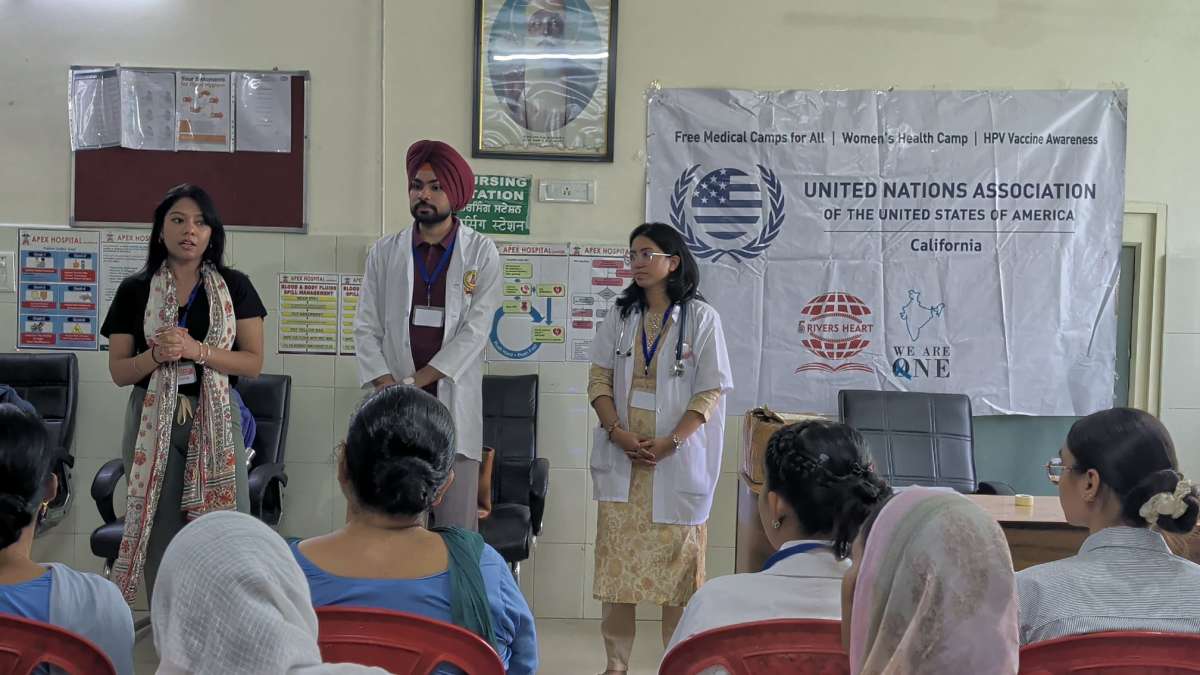
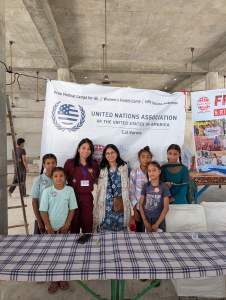


Hello everybody, my name is Sonya Bhatti, and I'm a Family Medicine physician and a Health Advocate with the United Nations Association-California. I recently got back from my trip in India. I had the chance to visit 15+ villages in Punjab, India, to help spread awareness of the HPV vaccine and cervical cancer prevention. As some of you don't know, every 8 minutes a woman dies from cervical cancer in India. Cervical cancer is currently the only cancer we know how to prevent; no other cancer has a comparable prevention method available today. India, in partnership with WHO, has rolled out an initiative that offers a free single-dose HPV vaccine for 14-year-old girls.
The initiative was highly successful.
Looking back, two things stand out clearly: people are either unaware of the HPV vaccine entirely, or they've been misled by misinformation. One of the most common things we heard was comparisons to the COVID vaccine, but what many people don't realize is that this vaccine has been around for a long time. I got it myself about 20 years ago.
One of the doctors I featured on Instagram said something that really stayed with me: "Influencers have hijacked the purpose of the HPV vaccine by spreading misinformation." And he's right. But here's what gives me hope: counseling people one on one, with honesty and compassion, works. So many of the doctors who joined our camps volunteered, including male physicians. And the response we received was overwhelmingly positive.
We talked openly about how the virus is transmitted. We answered every question. And not once, not one single time, did anyone respond with anger or offense. In fact, women across all age groups were asking where they could get the vaccine administered.
One of our last camps was held in a vaccine clinic. One doctor notified me that they can hardly get two girls vaccinated a month, but after counseling that day, around 15 girls agreed to receive the vaccination that day. I recently spoke to him on the phone, and he's had about two to three girls come in daily to get vaccinated. At least 45+ girls have been vaccinated in the last 2 weeks!
Two key barriers continue to remain: HPV vaccine awareness and covering costs for girls and women older than 15.
I am hopeful that the HPV vaccine will be included in the UIP in India one day. I truly believe that in our lifetime, we will see the day when cervical cancer rates drop not only in India but in the world. I want to thank United Nations Association-California for allowing me to help target SGD #3 and 5 Rivers Heart Association. I can't wait to continue with this work.