
This year in 2026 we hope to expand on the impact we made in 2025 by continuing to serve rural Kenya. Our previous team of orthopedic surgeons, physicians, anesthesiologists, PAs, nurses, and physical therapists helped 3,164 people in Kisii, Kenya in Africa. Not only did we help the individual, we helped them heal and find purpose so they can contribute to their families and communities. We plan to surpass this previous achievement in 2026 in addition to teaching their health care providers and staff how we practice medicine in the USA.
The medical personnel and people of Kisii County will benefit from our efforts. This population was chosen because one of our own surgeons was born in Nairobi, and he has elderly family who reside in Kisii county. Their population frequently suffer devastating injuries, and they are not able to support their families. I have learned that one person often provides financially to multiple members of their immediate and extended family, so if they cannot work, it becomes a problem for many. The economy is largely agricultural, so if they cannot use a hand, arm or cannot walk, they cannot work. Our teaching has also helped them become more efficient with their time, which has led to more people being served.
This will be the 3rd annual trip for us, and we have established important relationships in the community. People have come from all around Eastern African and the surrounding region to seek help, and they expect our return. We hope to overcome our previous impact of helping 3,164 people with a larger team and broader specialty base. We wish that our ability to help others can foster hope for a better health care system for the people of Kenya. It is our mission to continue to deliver a high level of care that can serve as the standard of care for future generations.
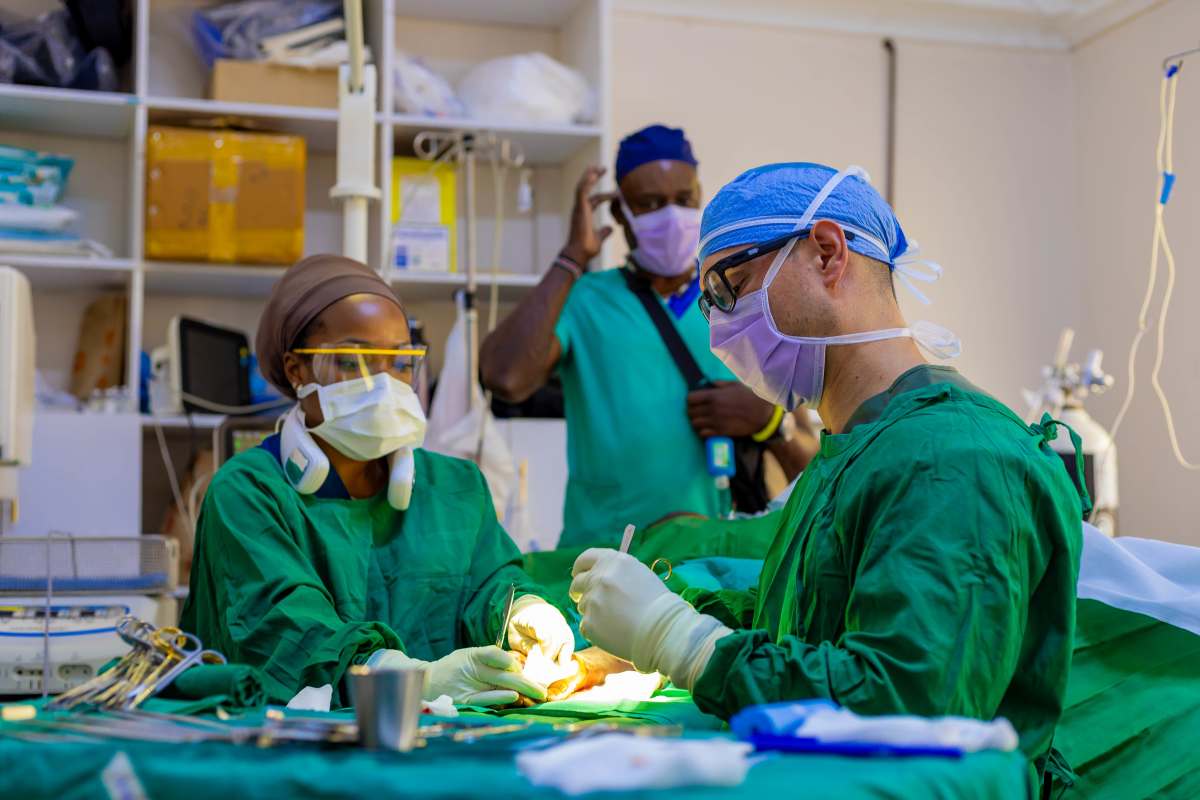




It’s honestly hard to explain what this trip to Kenya meant to me. This is the third time I have traveled for this particular purpose.
We helped more than 2,500 people and performed over 30 orthopedic procedures, including total hip and knee replacements, trauma cases involving both the upper and lower extremities, pediatric burn contractures, chronic non-unions, and severe foot and ankle injuries.
Some of these patients had been living with pain, deformity, or limited function for years. Things that we may be able to treat relatively quickly here can completely change someone’s life when access to orthopedic care is limited.
One gentleman traveled across the country from Mombasa as he missed our medical mission last year in 2025. He lived with a non-union of his left humerus for 13 years, and we were able to help him. He still has a young family for which to provide.
We provided more than a million dollars in free orthopedic surgeries and implants, and that doesn’t even include anesthesia or many of the other costs involved in their care.
But the money really isn’t what sticks with me, but it is important to note.
What sticks with me is thinking about what happens after we leave.
Someone who can walk with less pain may be able to go back to work. A parent may be able to take care of their kids again. Someone who has been limited by an injury for years may finally have some independence back. A child who burned themselves years ago may finally be able to use their hand to play again.
When you help one person, you’re rarely helping just one person.
You’re helping their family, their children, and sometimes an entire community that depends on them. That ripple effect is impossible to put a number on.
As a physician assistant, this trip gave me a different perspective on the work I do every day. I’m fortunate to have spent years learning orthopedics, working in the operating room, and taking care of patients. Being able to take those skills somewhere they were truly needed made me appreciate my profession in a completely different way.
When I returned, I definitely had moments when I stopped to reflect and thought about how lucky I am to be able to do this for a living.
We see injuries, X-rays, diagnoses, and surgeries every day, and sometimes it’s easy to get caught up in the routine of medicine. This trip reminded me that behind every case is a person who just wants to get back to their life.
They want to work. They want to take care of their family. They want to walk without pain. They want to be independent. And sometimes something that feels routine to us can mean everything to them. The routine of what I do is what was stuck out to me this time, and even though it felt routine, it certainly was not received that way. This is what made the trip so special.
The people we met in Kenya were incredibly grateful, but I think I came home just as grateful. Grateful for the opportunity to serve. Grateful for the team I was able to work alongside. And grateful that the career I chose gives me the ability to make a real difference in someone’s life.
None of this would have been possible without the physicians, PAs, nurses, therapists, anesthesia teams, volunteers, local healthcare workers, donors, and everyone behind the scenes who helped make the mission happen.
It took a lot of people coming together for one purpose. To help. I hope this isn’t the last time I get the opportunity to do something like this.
I would love to continue serving communities where access to orthopedic care is limited and where our skills can have such a meaningful impact.
Kenya reminded me why I went into healthcare in the first place.
Sometimes we may never fully see how far the impact of helping one person reaches.
But knowing that someone may now be able to walk better, work again, take care of their family, or simply live with less pain is more than enough reason to keep doing it.

